Poker Outs Chart: Odds for 1 to 15 Outs
An out is any unseen card that turns your hand into the winner, and the whole chart below comes from one fact: after the flop there are 47 cards you have not seen. Nine outs on the flop means you complete by the river 35.0% of the time and on the very next card 19.1% of the time. Everything else is that same division repeated.
Count the outs, read the row, compare it to the price you are being offered. That is the entire skill.
The poker outs chart
Held on the flop, with 47 unseen cards:
| Outs | By the river (2 cards) | Next card only | Odds against (by river) |
|---|---|---|---|
| 1 | 4.3% | 2.1% | 22 : 1 |
| 2 | 8.4% | 4.3% | 11 : 1 |
| 3 | 12.5% | 6.4% | 7.0 : 1 |
| 4 | 16.5% | 8.5% | 5.1 : 1 |
| 5 | 20.4% | 10.6% | 3.9 : 1 |
| 6 | 24.1% | 12.8% | 3.1 : 1 |
| 7 | 27.8% | 14.9% | 2.6 : 1 |
| 8 | 31.5% | 17.0% | 2.2 : 1 |
| 9 | 35.0% | 19.1% | 1.9 : 1 |
| 10 | 38.4% | 21.3% | 1.6 : 1 |
| 11 | 41.7% | 23.4% | 1.4 : 1 |
| 12 | 45.0% | 25.5% | 1.2 : 1 |
| 13 | 48.1% | 27.7% | 1.1 : 1 |
| 14 | 51.2% | 29.8% | 0.95 : 1 |
| 15 | 54.1% | 31.9% | 0.85 : 1 |
One denominator note that matters. The “next card” column divides by 47, because that is the situation on the flop. Once the turn is dealt there are only 46 unseen cards, so the same draw is very slightly better: a nine-out flush draw goes from 19.1% to 19.6%, an eight-out straight draw from 17.0% to 17.4%, and a four-out gutshot from 8.5% to 8.7%. Half a percentage point never changes a decision, but it is worth knowing why two charts disagree.
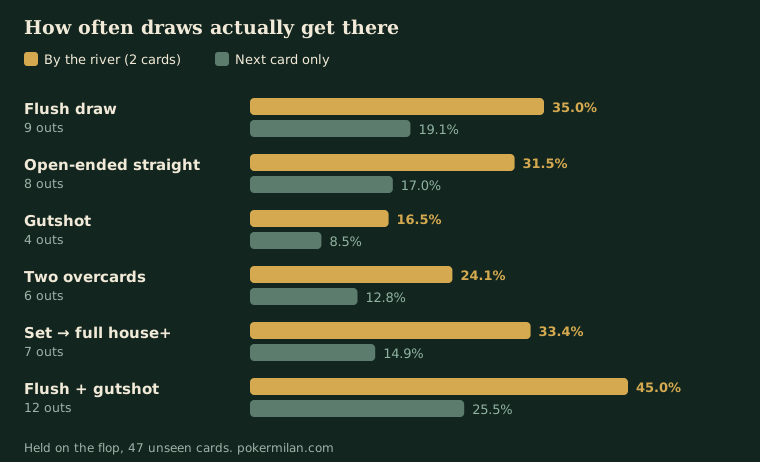
Common draws and their out counts
| Draw on the flop | Outs | By the river | Next card |
|---|---|---|---|
| Flush draw | 9 | 35.0% | 19.1% |
| Open-ended straight draw | 8 | 31.5% | 17.0% |
| Gutshot (inside straight) | 4 | 16.5% | 8.5% |
| Two overcards | 6 | 24.1% | 12.8% |
| Pocket pair to a set | 2 | 8.4% | 4.3% |
| Pair to two pair or trips | 5 | 20.4% | 10.6% |
| Flush draw + gutshot | 12 | 45.0% | 25.5% |
| Flush draw + open-ended | 15 | 54.1% | 31.9% |
| Set to a full house or better | 7 | 33.4% | 14.9% |
The last row is the one exception to the chart. A set has seven immediate outs to fill up, but it also improves when the turn brings a brand-new rank and the river pairs it — a runner-runner board pair still gives you a full house. That extra path lifts the true by-the-river figure to 33.4%, above the 27.8% that seven plain outs would give. Any draw with runner-runner equity beats its raw out count slightly.
How to count outs without double-counting
The single most common counting error is adding the same card twice. Work through a real combo draw.
You hold J♠ T♠. The flop is 9♠ 8♦ 2♠.
- Flush outs. There are 13 spades. You can see four of them (J♠, T♠, 9♠, 2♠), so 9 spades remain.
- Straight outs. You have an open-ended draw: any queen makes Q-J-10-9-8, any seven makes J-10-9-8-7. That is 4 + 4 = 8 cards.
- Subtract the overlap. The Q♠ and the 7♠ are already in the flush count. Counting them again would inflate the total. Take off 2.
- Total: 9 + 8 − 2 = 15 clean outs, worth 54.1% by the river.
Naive addition gives 17 outs and 60%, which is nearly six percentage points of imaginary equity — enough to turn a fold into a call in exactly the spots where that matters most.
Three rules stop this happening:
- Count by card, not by draw. List the actual cards that help, then remove duplicates. Fifteen is the practical maximum for a two-card holding.
- Never count your own cards. With A♥ K♦ on a Q-8-3 flop you have six outs, not eight — three aces and three kings remain, because you hold one of each.
- Board-pairing cards are usually not outs. If a card that makes your straight also pairs the board, it hands somebody a full house at the same time.
Discounted outs: when an out is not really an out
An out only counts if the card makes you the winner, not merely a made hand. Cards that complete your draw and someone else’s better one are worth close to nothing, and they cost you more than a miss because you pay them off.
Straight draw on a two-flush board. You hold 9♥ 8♥ on Q♠ 7♠ 6♣. Any ten or five makes your straight — 8 outs. But the 10♠ and 5♠ put a third spade out there, and anyone drawing to the flush now beats you. Count 6 clean outs (24.1%), not 8 (31.5%). That seven-point gap is the difference between calling and folding against a pot-sized bet.
The idiot end. Board is 7♠ 6♣ 2♥ and you hold 5♦ 4♦. An eight completes 8-7-6-5-4 — and gives anyone holding 10-9 the bigger straight. The low end of a straight draw deserves a heavy discount, because the hands that call flops like that one are exactly the hands that hold 10-9.
Weak flush draws. Holding 6♠ 4♠ with two spades on board, the third spade gives you a flush that loses to every larger spade in the deck. Nine outs is the raw number; six or seven is the honest one. Nut draws get their full count, everything else takes a haircut.
Overcard outs against a real range. A-K on a Q-8-3 board is nominally six outs, but if your opponent has a queen, hitting an ace only makes you second best. Against a tight range, treat overcards as three or four outs, not six.
The practical rule: subtract roughly one out for each way the card can betray you. When to fold in poker covers the spots where the honest count says fold and the hopeful count says call.
The rule of 4 and 2
You will not do hypergeometric arithmetic at a table. Use this instead:
Two cards to come: outs × 4. One card to come: outs × 2.
It is accurate enough for almost every decision, and here is exactly how wrong it gets:
| Outs | × 4 estimate | True by river | Error |
|---|---|---|---|
| 4 | 16% | 16.5% | −0.5 |
| 6 | 24% | 24.1% | −0.1 |
| 8 | 32% | 31.5% | +0.5 |
| 9 | 36% | 35.0% | +1.0 |
| 12 | 48% | 45.0% | +3.0 |
| 15 | 60% | 54.1% | +5.9 |
The ×4 shortcut is near-perfect up to about nine outs, then starts overestimating. Above 12 outs, subtract about 4 points and you are back inside rounding error. The ×2 version errs the other way and always slightly undershoots — 9 × 2 = 18% against a true 19.1% — which is a safe direction to be wrong in.
The trap that costs the most money: ×4 assumes you actually get to see both remaining cards. That is only guaranteed when someone is already all-in. If your opponent will bet the turn as well, price the flop call with ×2, then re-evaluate. Treating a flop call as a purchase of two cards, when it only buys one, is the most expensive arithmetic mistake in low-stakes poker.
Turning outs into a decision
Outs are half the equation. The other half is the price:
Required equity = call ÷ (pot + call)
Flop 9♠ 6♠ 2♦, you hold A♠ K♠, pot is $60 and your opponent bets $30. The price is 30 ÷ 120 = 25% needed. Your nine flush outs are worth 19.1% for one card, plus some value in the overcards — a marginal call that gets better in position and worse out of it. The full method, including implied and reverse implied odds, is in pot odds explained, and position explains why the same draw is worth more when you act last.
Two caveats worth keeping:
- Omaha outs do not work this way. With four hole cards, draws are far bigger and overlap constantly — see Omaha poker rules.
- Small pocket pairs are an implied-odds draw, not a pot-odds draw. Two outs to a set is 8.4% by the river, so the call is only justified by what you win later; pocket pairs strategy has the stack-depth rule.
Drilling it
Run your own hands through the free odds calculator after a session and check your counts against the real numbers. Thirty reviewed hands and the common flop textures stop needing thought. For the underlying combinatorics, see poker hand probabilities; for the numbers worth memorising in one place, use the poker probability cheat sheet; and if any of the hand rankings themselves are still shaky, start with the poker hand rankings chart.
Keep learning: try the free poker odds calculator, memorize the hand rankings, or browse all strategy guides.