Poker Cheat Sheet: The Odds Worth Memorizing
The mathematical side of poker runs on about forty numbers, and all of them fit on this page. What you get dealt, what the flop delivers, what your draws complete, how the classic all-in matchups split, and what every bet size demands before you can call it — or bluff with it. Memorize these tables and the arithmetic is done before you sit down.
Five-card hand odds
There are exactly 2,598,960 possible five-card poker hands. Every ranking category is a share of that total, and the ranking order is the frequency order — rarer always beats commoner.
| Hand | Combinations | Probability | Roughly |
|---|---|---|---|
| Royal flush | 4 | 0.000154% | 1 in 649,740 |
| Straight flush | 36 | 0.00139% | 1 in 72,193 |
| Four of a kind | 624 | 0.0240% | 1 in 4,165 |
| Full house | 3,744 | 0.144% | 1 in 694 |
| Flush | 5,108 | 0.197% | 1 in 509 |
| Straight | 10,200 | 0.392% | 1 in 255 |
| Three of a kind | 54,912 | 2.11% | 1 in 47 |
| Two pair | 123,552 | 4.75% | 1 in 21 |
| One pair | 1,098,240 | 42.3% | 1 in 2.4 |
| High card | 1,302,540 | 50.1% | 1 in 2 |
Half of all five-card hands are nothing at all, and another 42% are a single pair — which is why so much of hold’em is two players arguing over one pair. The combinatorial derivations behind every row are worked through in poker hand probabilities.
What you get dealt
Two cards from 52 gives C(52,2) = 1,326 combinations, which collapse into 169 strategically distinct hands: 13 pocket pairs, 78 suited hands and 78 offsuit hands.
| You are dealt | Combos | Probability | Odds against |
|---|---|---|---|
| A specific pocket pair (say, AA) | 6 | 0.45% | 220 : 1 |
| Any pocket pair | 78 | 5.9% | 16 : 1 |
| AK, suited or offsuit | 16 | 1.2% | 82 : 1 |
| AK suited | 4 | 0.30% | 331 : 1 |
| Two cards ten or higher | 190 | 14.3% | 6 : 1 |
| Any two suited cards | 312 | 23.5% | 3.3 : 1 |
Aces arrive once every 221 hands; if it feels rarer than that, that is memory, not the deck. Any pocket pair shows up about once every 17 hands, and nearly a quarter of your holdings are suited — a fact worth exactly one extra flush every 118 flops, as the next table shows.
What the flop delivers
| Holding | Flop result | Probability | Odds against |
|---|---|---|---|
| Pocket pair | Flops a set | 11.8% | 7.5 : 1 |
| Two unpaired cards | Pairs at least one | 32.4% | 2.1 : 1 |
| Two unpaired cards | Flops two pair (both cards) | 2.0% | 49 : 1 |
| Two suited cards | Flops a flush | 0.84% | 118 : 1 |
| Two suited cards | Flops a flush draw | 10.9% | 8.1 : 1 |
Two of these rows run the economics of small-stakes poker. Unpaired cards miss the flop two times in three, so most hands are decided by who keeps betting after missing. And a pocket pair spikes its set roughly once in 8.5 attempts, which is why set-mining only pays when the stacks are deep enough to cover all the misses.
Draw completion odds
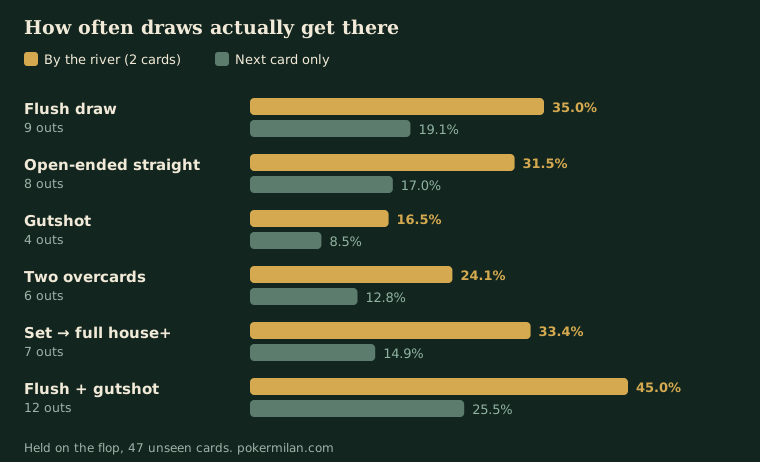
Held on the flop, with 47 unseen cards:
| Draw | Outs | By the river | Next card |
|---|---|---|---|
| Flush draw | 9 | 35.0% | 19.1% |
| Open-ended straight draw | 8 | 31.5% | 17.0% |
| Two overcards | 6 | 24.1% | 12.8% |
| Gutshot | 4 | 16.5% | 8.5% |
| Set to a full house or better | 7 | 33.4% | 14.9% |
At the table, use the rule of 4 and 2: outs times four with two cards to come, outs times two with one. It lands within a point or two of the true figure for every simple draw here; only the set row outruns it, because the turn pairing the board adds fresh outs. The complete version for 1 through 15 outs — with the rules for counting outs without double-counting, and for discounting the dirty ones — is in the poker outs chart.
The classic all-in matchups
| Matchup | Example | Equity split |
|---|---|---|
| Pair vs two overcards | QQ vs AK | ~55 / 45 |
| Pair vs one overcard | TT vs A6 | ~70 / 30 |
| Overpair vs underpair | AA vs KK | ~80 / 20 |
| Dominated ace | AK vs AQ | ~74 / 26 |
Four splits cover nearly every preflop all-in you will ever take. The famous “coin flip” is barely an edge at 55/45, so racing with queens against ace-king is close to neutral either way. Domination is the opposite: AQ against AK wins only about a quarter of the time, which is the whole argument for not stacking off with the second-best ace. And pair-over-pair is a four-to-one massacre — the reason cold four-bet pots are so expensive to be wrong in.
Break-even percentages by bet size
Every bet carries two numbers: the equity a caller needs to break even, and how often the same bet must succeed as a bluff.
| Bet size | Caller needs | A bluff must work |
|---|---|---|
| 1/3 pot | 20% | 25% |
| 1/2 pot | 25% | 33.3% |
| 2/3 pot | 28.6% | 40% |
| 3/4 pot | 30% | 42.9% |
| Full pot | 33.3% | 50% |
| 2x pot | 40% | 66.7% |
Read it in both directions. Facing a pot-sized bet, you need 33.3% equity to call; a half-pot bet needs 25%; a third-pot bet needs 20%. Making a pot-sized bluff, you need a fold half the time. Note the asymmetry: the bluff column is always higher than the call column, because the bluffer risks a full bet to win only the pot while the caller’s price includes the bet itself. Comparing these thresholds against the draw table above is the core calling decision, and the full method — including implied and reverse implied odds — is in pot odds explained.
Starting hands at a glance
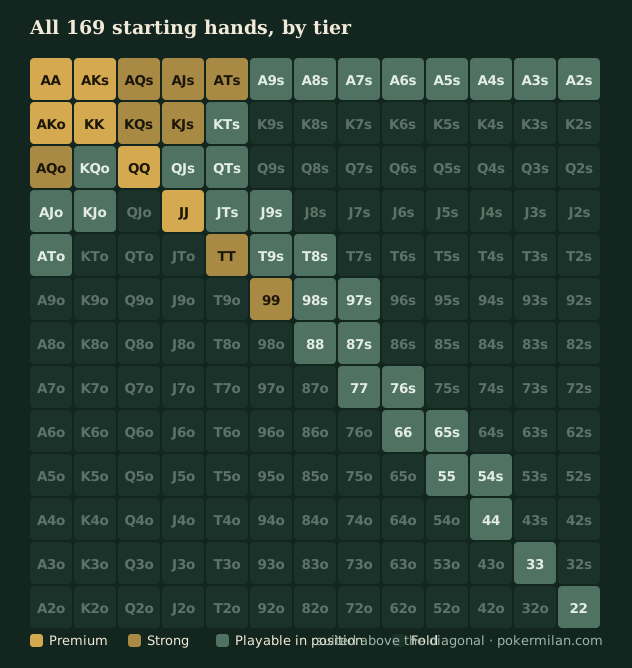
The tiers compress a lot of equity math into one picture, but the number that moves most is not printed on it: your seat. A disciplined under-the-gun range opens roughly 15% of hands; the button profitably opens around 44%. The same suited connector is a fold in one seat and a raise five seats later, which is why memorizing a single list of “good hands” fails. The preflop chart turns the tiers into open-or-fold decisions seat by seat, the starting hand rankings explain why each hand sits where it does, and position in poker covers why the gap between 15% and 44% exists at all.
Sanity checks people get wrong under pressure
- A flush beats a straight. 5,108 flush combos against 10,200 straights — rarer wins, every time.
- A straight beats three of a kind, for the same reason: 10,200 against 54,912.
- The wheel, A-2-3-4-5, is a five-high straight. The ace plays low, so its top card is the five and it loses to 2-3-4-5-6.
- Two pair beats one pair regardless of rank. Threes and twos beat a pair of aces.
- A royal flush is not a separate category. It is the ace-high straight flush — the top 4 of the 40 straight-flush combinations.
The full ordering with every tie-breaker is in what beats what in poker, and the printable version lives on the hand rankings page.
What to memorize first
If forty numbers is too many for one sitting, take them in this order:
- Three prices: a third-pot bet needs 20%, half-pot needs 25%, full pot needs 33.3%.
- One shortcut: outs times 4 on the flop, times 2 on the turn.
- Four splits: 55/45, 70/30, 80/20, 74/26.
That is nine numbers, and they settle the large majority of real decisions. Everything else on this page is refinement. To test yourself, deal out spots in the free odds calculator and estimate before it answers — twenty hands of that and the tables above stop being tables and start being reflexes.
Keep learning: try the free poker odds calculator, memorize the hand rankings, or browse all strategy guides.