Poker Hand Rankings Chart: Every Hand Ranked
Poker hand rankings run from royal flush at the top to high card at the bottom, and the order is decided by one thing only: how hard each hand is to make. There are exactly 2,598,960 possible five-card hands in a 52-card deck, and every ranking below is just those hands sorted by how few ways there are to build them.
This page is built to be printed, screenshotted and kept. The chart comes first, the tie-break rules second, and the three rankings people consistently get wrong last.
The poker hand rankings chart
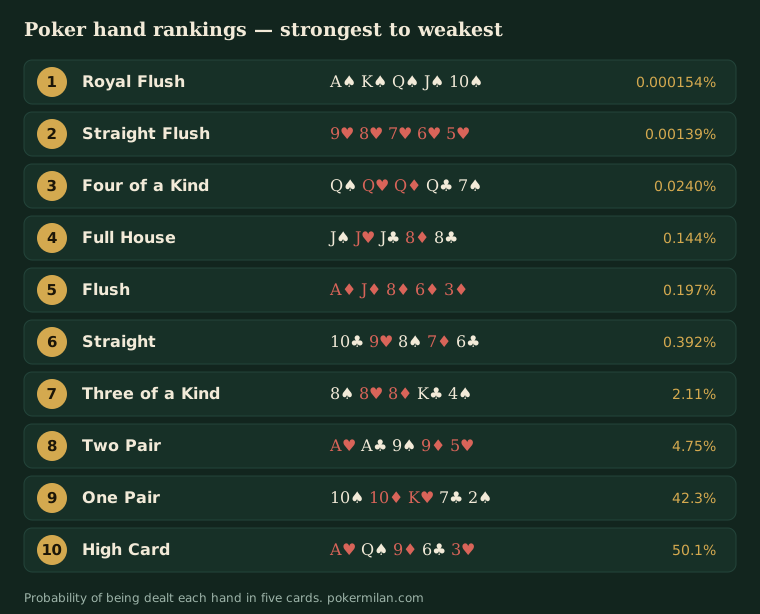
| # | Hand | Example | Combinations | Probability | Odds against |
|---|---|---|---|---|---|
| 1 | Royal flush | A♠ K♠ Q♠ J♠ 10♠ | 4 | 0.000154% | 649,739 : 1 |
| 2 | Straight flush | 9♥ 8♥ 7♥ 6♥ 5♥ | 36 | 0.00139% | 72,192 : 1 |
| 3 | Four of a kind | Q♠ Q♥ Q♦ Q♣ 7♠ | 624 | 0.0240% | 4,164 : 1 |
| 4 | Full house | J♠ J♥ J♣ 8♦ 8♣ | 3,744 | 0.144% | 693 : 1 |
| 5 | Flush | A♦ J♦ 8♦ 6♦ 3♦ | 5,108 | 0.197% | 508 : 1 |
| 6 | Straight | 10♣ 9♥ 8♠ 7♦ 6♣ | 10,200 | 0.392% | 254 : 1 |
| 7 | Three of a kind | 8♠ 8♥ 8♦ K♣ 4♠ | 54,912 | 2.11% | 46 : 1 |
| 8 | Two pair | A♥ A♣ 9♠ 9♦ 5♥ | 123,552 | 4.75% | 20 : 1 |
| 9 | One pair | 10♠ 10♦ K♥ 7♣ 2♠ | 1,098,240 | 42.3% | 1.37 : 1 |
| 10 | High card | A♥ Q♠ 9♦ 6♣ 3♥ | 1,302,540 | 50.1% | 0.995 : 1 |
The combinations column adds to exactly 2,598,960. That is the whole system: each category counts only the hands that do not qualify for a higher one, which is why a straight flush is never also counted as a flush, and why the 5,108 flushes exclude the 40 hands that are straight flushes.
These percentages describe five random cards — a dealt hand in five-card draw, or any made hand measured against the full deck. In Texas Hold’em you get to use seven cards, so strong hands turn up far more often than the table suggests. Those seven-card figures are worked through in poker hand probabilities.
Reading the chart properly
Two rows sit exactly where the confusion lives. A flush is 0.197% and a straight is 0.392%, so straights are almost precisely twice as common and rank below. Three of a kind at 2.11% is more than five times as common as a straight, so the straight outranks it in turn. Rarity, all the way down the ladder.
Notice as well that one pair or worse covers 92.4% of every five-card hand dealt. If it feels like you never make anything, that is not bad luck, that is arithmetic.
Tie-break rules for every hand class
Two players regularly finish in the same category. The rule is always the same: compare the ranks that define the hand, then compare the remaining cards in descending order, and if all five match, split the pot. Suits never break a tie in standard poker — the reasoning is set out in poker suits ranking.
| Hand class | How the tie is broken |
|---|---|
| Royal flush | Cannot be beaten. Two royals always split. |
| Straight flush | Highest top card wins. The steel wheel, 5-4-3-2-A, is the lowest. |
| Four of a kind | Higher quads win. If the quads sit on the board, the highest fifth card decides. |
| Full house | Compare the three of a kind first, then the pair. |
| Flush | Compare highest card, then second, third, fourth, fifth. |
| Straight | Highest top card only. A-2-3-4-5 counts as five-high. |
| Three of a kind | Higher trips, then the higher kicker, then the second kicker. |
| Two pair | Higher top pair, then the lower pair, then the single kicker. |
| One pair | Higher pair, then three kickers in descending order. |
| High card | Highest card, then each next card in turn, through all five. |
The kicker is the part beginners skip. A poker hand is always exactly five cards, so the leftovers still count. A pair of kings with an ace kicker beats a pair of kings with a queen kicker, and that showdown happens far more often than any flush ever will. The rank order of individual cards is listed in poker card values.
Worked tie-break examples
Flush versus flush. Player A has A♠ J♠ 8♠ 5♠ 3♠; Player B has A♥ K♥ 4♥ 3♥ 2♥. Both hold an ace-high flush, so move to the second card: king beats jack. B wins. The ace of spades is not worth more than the ace of hearts.
Full house versus full house. Board: 8♠ 8♥ 3♦ 3♣ K♠. Player A holds 8♦ 4♣ for eights full of threes. Player B holds K♦ K♥ for kings full of eights. Compare the trips first — kings beat eights — so B wins, and the pairs are never consulted. More on this class in full house in poker.
Quads with a kicker. Board: 7♠ 7♥ 7♦ 7♣ 9♠. Everyone has four sevens, so the fifth card decides it. A holds A♥ 2♦ (quads, ace kicker), B holds K♦ Q♦ (quads, king kicker). A wins.
Two pair and the fifth card. Board: K♠ 9♦ 4♥ 9♠ 2♣. A holds K♥ Q♦, B holds K♦ J♣. Both make kings and nines; the kicker separates them, and a queen beats a jack. A wins by one rank. This is the most common way money moves at low stakes — see two pair in poker for the version where both pairs are contested.
Playing the board. If the board runs out A♠ K♠ Q♠ J♠ 10♠, every remaining player holds a royal flush and the pot is split, whatever their hole cards are. You always make the best available five-card hand, and it does not have to contain a card of your own.
The three rankings people get wrong
1. A flush beats a straight. This is the most-searched ranking question in poker, and it is not close: 5,108 flush combinations against 10,200 straights. Straights are twice as likely, so they rank below. The full breakdown lives in does a flush beat a straight.
2. A straight beats three of a kind. Trips feel powerful because three cards match, but there are 54,912 ways to make three of a kind and only 10,200 ways to make a straight. Straights are more than five times rarer, so they win. On a connected board, a set is often already behind.
3. A-2-3-4-5 is a five-high straight, not an ace-high one. The wheel is the lowest straight in poker. The ace plays low, the five is the top card, and 6-5-4-3-2 beats it. The ace is the only rank that works at either end: A-K-Q-J-10 is the highest straight, A-2-3-4-5 the lowest, and the ranks do not wrap around — Q-K-A-2-3 is nothing at all.
A fourth worth adding: there is no ranking below high card. When nobody pairs, the highest single card takes it, so hands like A-9-6-4-2 win real pots. That happens more often than any made hand, as high card in poker sets out.
Memorising the order
Learn the four boundary pairs and the rest rebuilds itself, because nobody confuses quads with a pair:
- Full house over flush
- Flush over straight
- Straight over three of a kind
- Three of a kind over two pair
Recite those four and you can reconstruct the whole ladder from either end.
Where to go next
- What beats what in poker — the same information written as a lookup you can scan in the middle of a hand.
- The hand rankings reference — every hand with its own page, including royal flush odds.
- How to play poker for beginners — if you still need the betting rounds and table mechanics.
- The poker probability cheat sheet — once the rankings are automatic, these are the numbers that change decisions.
Rankings are the price of entry, not an edge — everyone at the table already knows them. The real edge starts one page later, with which hands are worth playing and what a draw is actually worth.
Keep learning: try the free poker odds calculator, memorize the hand rankings, or browse all strategy guides.