What Beats What in Poker: The Full Lookup
In poker the order is fixed: royal flush beats straight flush beats four of a kind beats full house beats flush beats straight beats three of a kind beats two pair beats one pair beats high card. Anything higher on that list beats everything below it, every time, with no exceptions for suits.
This page is written as a lookup rather than a lesson. Find your hand, read the two lines under it, and you have your answer.
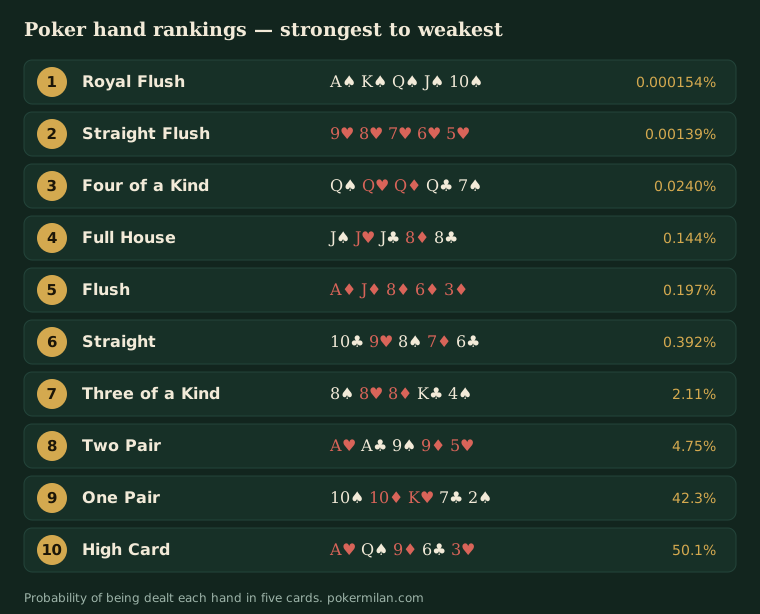
Hand by hand: what beats it, what it beats
Royal flush
Loses to: nothing. Beats: every other hand.
A royal flush is A-K-Q-J-10 all in one suit. It is the top of the ladder and cannot be outdrawn. If two players somehow hold one, they split the pot — a spade royal does not beat a heart royal.
Straight flush
Loses to: a higher straight flush, and a royal flush. Beats: everything else, including four of a kind.
Five cards in sequence, all one suit, such as 9♥ 8♥ 7♥ 6♥ 5♥. Between two straight flushes the higher top card wins, and the lowest of them all is the “steel wheel”, 5-4-3-2-A. Rarity figures are in straight flush probability.
Four of a kind
Loses to: higher four of a kind, straight flush, royal flush. Beats: full house, flush, straight, three of a kind, two pair, one pair, high card.
Four cards of one rank plus a fifth card. Four aces beat four kings. When the quads are on the board and shared, the highest fifth card decides the pot.
Full house
Loses to: a bigger full house, four of a kind, straight flush, royal flush. That is the complete list — four hands. Beats: flush, straight, three of a kind, two pair, one pair, high card.
Three of a rank plus a pair. Between two full houses, compare the trips first: kings full of twos beats twos full of kings. The pair only matters when the trips are identical. See full house in poker.
Flush
Loses to: a higher flush, full house, four of a kind, straight flush, royal flush. Beats: straight, three of a kind, two pair, one pair, high card.
Five cards of one suit, not in sequence. Between two flushes, compare highest card, then second, then third, and so on. The suit itself is irrelevant — an ace-high flush in clubs and an ace-high flush in hearts are identical in strength, and the next card decides.
Straight
Loses to: a higher straight, flush, full house, four of a kind, straight flush, royal flush. Beats: three of a kind, two pair, one pair, high card.
Five cards in sequence, mixed suits. The highest top card wins. A-2-3-4-5 is a five-high straight and the lowest one there is; A-K-Q-J-10 is the highest. Ranks do not wrap around, so Q-K-A-2-3 is not a straight at all.
Three of a kind
Loses to: higher trips, straight, flush, full house, four of a kind, straight flush, royal flush. Beats: two pair, one pair, high card.
Three cards of the same rank. Between two sets, the higher rank wins; if the trips are shared on the board, the two kickers decide in order.
Two pair
Loses to: higher two pair, three of a kind, and everything above that. Beats: one pair and high card only.
Two cards of one rank, two of another, plus a kicker. Compare the higher pair first, then the lower pair, then the fifth card. Aces and twos beats kings and queens. Two pair in poker covers the kicker traps in detail.
One pair
Loses to: a higher pair, two pair, and everything above. Beats: high card only.
Two cards of the same rank plus three kickers. Higher pair wins; equal pairs go to the first, then second, then third kicker. This is where most real pots are decided, because one pair is dealt 42.3% of the time.
High card
Loses to: every made hand, and any higher high card. Beats: a lower high card.
No pair, no straight, no flush. Compare the highest card, then the next, through all five. Ace-high beats king-high; A-9-6-4-2 beats A-8-7-5-3 on the second card. High card in poker explains why these hands win more often than beginners expect.
Quick answers
Does a flush beat a straight?
Yes. A flush always beats a straight. There are 10,200 ways to make a straight and only 5,108 ways to make a flush, so a flush is twice as rare and outranks it. The long answer is in does a flush beat a straight.
Does a straight beat three of a kind?
Yes. Three of a kind comes up 54,912 ways against a straight’s 10,200 — more than five times as often — so the straight is the stronger hand.
What beats a full house?
Only four things: four of a kind, a straight flush, a royal flush, and a bigger full house. A flush does not beat a full house. Neither does a straight, and neither does three of a kind.
Does three of a kind beat two pair?
Yes. Two pair is dealt 4.75% of the time and three of a kind 2.11%, so trips are the rarer, stronger hand. Two pair beats one pair, and nothing more.
Does two pair beat a straight?
No. Two pair sits two rungs below a straight. Aces and kings still lose to 5-4-3-2-A.
Does a full house beat a flush?
Yes. Full house is 0.144%, flush is 0.197%. The full house is rarer, and it wins.
Does four of a kind beat a straight flush?
No. The only hands quads lose to are a bigger four of a kind, a straight flush, and a royal flush — which is itself the top straight flush.
Does a higher pair always beat a lower pair?
Yes. A pair of twos loses to a pair of threes regardless of kickers. Kickers only come into play when the pairs are the same rank.
Do suits ever break a tie?
No. In standard poker, spades are not worth more than hearts. Suits are used only for procedural decisions such as awarding a chip in a split pot or assigning a seat — never for ranking hands. See poker suits ranking.
Split pots and the five-card rule
When two hands are genuinely identical across all five cards, the pot is split. The rule that causes the most arguments is this one: your hand is always the best five cards available, and it does not have to use your hole cards. If the board is Q♠ J♠ 10♠ 9♠ 8♠, everybody still in has a queen-high straight flush and the pot splits, whatever anyone is holding.
The second rule that catches beginners: a sixth card never counts. In Texas Hold’em you have seven cards, but only the best five play. A pair of aces with K-Q-J does not beat a pair of aces with K-Q-J because your sixth-best card is a ten. That kicker never enters the comparison.
Using this at the table
The order is only useful if it is instant. Two habits get you there:
- Read the board first, then your hand. Ask what the board alone makes possible — is there a straight out there, three of a suit, a pair that allows a full house — before you look at what you have.
- Name your hand out loud in your head, all five cards. “Kings and nines with a queen” is a complete thought. “I have kings” is not, and it is how people call off stacks with the wrong kicker.
For the full chart with combinations, probabilities and worked tie-break examples, use the poker hand rankings chart. If you also need the betting rounds, blinds and showdown order, how to play poker for beginners walks through a complete hand, and the hand rankings reference has a page for every hand on this list.
Keep learning: try the free poker odds calculator, memorize the hand rankings, or browse all strategy guides.