How to Play Poker: A Complete Beginner's Guide
Poker is a card game where players make the best five-card hand from the cards they are dealt, and bet on who holds it. You win a pot either by showing the strongest hand at the end, or by betting enough that everyone else gives up first — and that second route is what makes it a game of skill rather than luck.
This page teaches the version everyone plays, Texas Hold’em, from the deck up: the rankings, the betting rounds, one complete hand card by card, and the handful of table manners that separate a new player from an annoying one.
What you need to know first
A standard 52-card deck, no jokers. Ranks run from 2 (lowest) to ace (highest), and the four suits — spades, hearts, diamonds, clubs — are all equal. A spade is never worth more than a heart.
Every player’s hand is exactly five cards. In Texas Hold’em you are dealt two private cards (“hole cards”) and share five community cards on the table, and you make the best five-card combination from those seven. You can use both hole cards, one, or neither.
The hand rankings, in brief
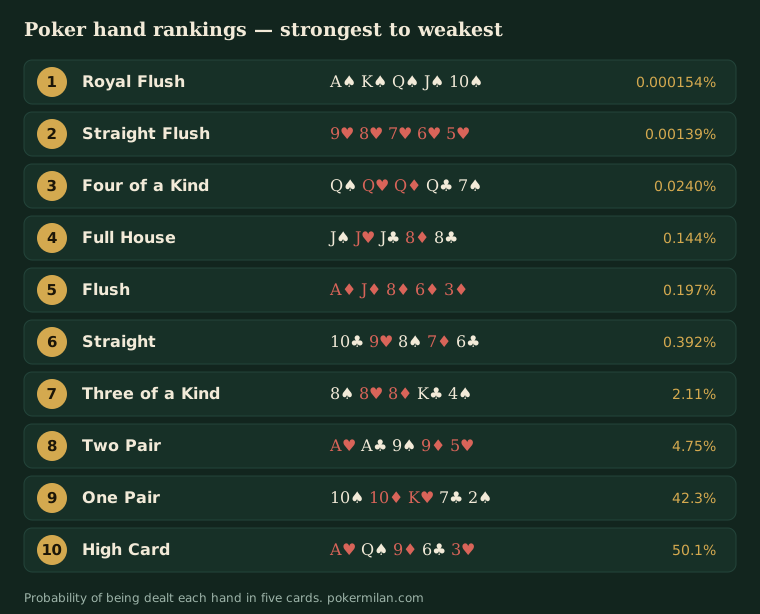
| Hand | What it is | Chance in five cards |
|---|---|---|
| Royal flush | A-K-Q-J-10, one suit | 0.000154% |
| Straight flush | Five in sequence, one suit | 0.00139% |
| Four of a kind | Four of the same rank | 0.0240% |
| Full house | Three of a rank plus a pair | 0.144% |
| Flush | Five of one suit | 0.197% |
| Straight | Five in sequence, mixed suits | 0.392% |
| Three of a kind | Three of the same rank | 2.11% |
| Two pair | Two pairs plus a fifth card | 4.75% |
| One pair | Two of the same rank | 42.3% |
| High card | None of the above | 50.1% |
The order is set purely by rarity. The two that beginners reverse: a flush beats a straight, and a straight beats three of a kind. Full detail sits in the poker hand rankings chart, and if you want it phrased as a lookup instead, use what beats what in poker.
The table: button and blinds
One seat holds the dealer button, a disc that moves one place clockwise every hand. The two players to its left post forced bets before any cards are dealt: the small blind and the big blind, typically $1 and $2 in a small cash game. Blinds exist to put money in the middle so there is something worth playing for.
The button matters more than beginners expect, because the player on it acts last on every betting round after the flop. Acting last is the single biggest structural advantage in poker — see position in poker.
A complete hand, card by card
Six players, $1/$2 blinds, everyone with $200 in front of them. You are on the button holding A♣ K♦.
Preflop
Everyone gets two hole cards. Action starts to the left of the big blind.
- The first three players fold.
- You raise to $6. A standard opening raise is three times the big blind.
- The small blind folds, giving up their $1.
- The big blind calls, adding $4 to the $2 already posted.
Pot: $13 ($6 from you, $6 from the big blind, $1 abandoned by the small blind).
The flop
The dealer burns one card and turns three face up: K♠ 9♥ 4♦. You now have a pair of kings with an ace kicker.
The big blind acts first from here on, because the button acts last.
- Big blind checks (passes the action without betting).
- You bet $7 into a $13 pot.
- Big blind calls. Pot: $27.
The turn
A fourth community card: 2♣. It changes nothing.
- Big blind checks. You bet $18. Big blind calls. Pot: $63.
The river
The fifth and last community card: 7♠. The final board reads K♠ 9♥ 4♦ 2♣ 7♠.
- Big blind checks. You bet $30. Big blind calls. Pot: $123.
Showdown
The last aggressor shows first. You table A♣ K♦ — kings, with A-9-7 alongside. The big blind shows K♥ J♣ — the same pair of kings, with J-9-7.
You win $123 because your ace outranks their jack as the fifth card. You put $61 in over four streets, so your profit is $62. Nobody made a flush, a straight or even two pair, and the pot was decided by a kicker — which is how most poker hands actually end.
The full street-by-street procedure, including burn cards and all-in situations, is in the Texas Hold’em rules.
The betting actions
There are five things you can ever do, and only some are legal at any moment.
| Action | When you can do it | What it means |
|---|---|---|
| Check | Only if nobody has bet this round | Pass the action, stay in for free |
| Bet | Only if nobody has bet this round | Put chips in and set a price |
| Call | Only if there is a bet to match | Match the current bet exactly |
| Raise | Only if there is a bet to match | Increase it; everyone must match the new amount |
| Fold | Any time it is your turn | Give up the hand and any chips already committed |
Two things beginners get wrong. You cannot check when there is a bet in front of you — the options are call, raise or fold. And chips you have already put in are not yours any more; “I’ve already got money in” is never a reason to call. The exact minimums, all-in rules and side pots are covered in poker betting rules.
Table etiquette that actually matters
None of this is snobbery. Every rule below exists because breaking it changes the outcome of somebody’s hand.
- Act in turn, always. Folding out of turn tells the players still to act that they are facing fewer opponents. Even a visible flinch toward your chips gives information away. Wait.
- No string bets. Either announce the amount out loud (“raise to twenty”) or push the chips in with one motion. Reaching back for more chips after your hand has crossed the line is a string bet, and the dealer will rule it a call.
- Protect your cards. Keep them on the table, in front of you, with a chip or card protector on top. Cards that touch the muck are dead, even if the dealer did it by accident, and you have no recourse.
- Do not slow-roll. If you have the winning hand at showdown, turn it over immediately. Pausing for effect while someone else believes they have won is the one breach that genuinely angers a table.
- Do not talk about a hand that is still live. Not even to the person next to you, not even after you have folded. It affects decisions still to be made.
- Do not splash the pot. Place your chips in a neat stack in front of you so everyone can count them, rather than throwing them into the middle.
- Keep your biggest chips visible. Hiding a large denomination behind smaller stacks misrepresents how much you have, and is against the rules everywhere.
What to learn next, in order
Work through these in sequence rather than jumping around. Each one assumes the one before it.
- Rankings until they are automatic. Use the hand rankings reference. You should be able to name your five-card hand instantly, including the kicker.
- Betting mechanics. Minimum raises, all-in rules and side pots, from poker betting rules.
- Which hands to play, and from where. Hand selection is the biggest single leak in beginner poker — start with Texas Hold’em starting hands and the preflop chart.
- Position. Why the button plays three times as many hands as the first seat: position in poker.
- Counting outs and prices. The poker outs chart followed by pot odds explained. These two turn guessing into arithmetic.
- Folding well. More money is saved by knowing when to fold than is ever made by fancy play. Read common poker mistakes alongside it.
Bluffing comes last, not first. It only works once the rest of your game is credible.
Before you play for anything
Poker is a game of skill played under variance, which means even correct decisions lose regularly in the short run. Decide in advance what you are willing to spend on learning, treat it as the cost of the hobby, and never chase losses. Our responsible gaming page sets out the limits, warning signs and support resources worth reading before you sit down rather than after. Play free games or low-stakes home games while the fundamentals are still forming — the lessons transfer completely, and the mistakes cost nothing.
Keep learning: try the free poker odds calculator, memorize the hand rankings, or browse all strategy guides.